A great story becomes even more impressive when you place it in context. This concept shows how AR brings that context into the exhibition space: the story of each artefact told right where it stands, adapted to the visitor in front of it.
We imagined how XR technologies could reshape museum interactions, adding layers of immersion and discovery.
The story next to the object
The Bodhisattva has lost parts of both arms over the centuries. AR rebuilds them in place, together with their meaning: the raised hand in Abhaya Mudra, the gesture of fearlessness, and the kundika, a water flask, in the left hand. The reconstruction is deliberately holographic, out of respect for the original. We are not trying to fool the eye with a realistic finish; the visitor always sees where the real object ends and the digital addition begins.
Decoding the hieroglyphs
The throne of Ramesses II is covered in hieroglyphs, and most visitors walk past them as ornament.
AR traces a single sign right on the stone and explains it in place: here, the falcon of the Horus name, the oldest form of a pharaoh's name. A wall of symbols turns into a text you can follow sign by sign.
Spatial terms, shown in space
Some art terms describe geometry, and geometry is easier to show than to tell. To explain contrapposto, AR draws the shoulder and hip axes directly on the Roman torso: the counter-tilt is visible at a glance, no diagram in a booklet needed. The same works for any spatial concept a wall label struggles with.
Built, not just imagined
This reel collects ideas we implemented in a fully working AR prototype, built for the Grand Egyptian Museum.
It recognises exhibits and anchors their stories right to the objects, on a real device in a real hall. The scenarios above come from this work, not from a render.
Together these scenarios form one system that runs across the whole museum. It reconstructs what is lost, makes inscriptions readable, and adapts what it shows to where each visitor stands. All of it was researched on site: the reel below is from our days at the Grand Egyptian Museum and the Giza plateau.
This project was created as a concept of our vision for XR technology within any museum environment. At the same time, all the scenarios we describe are grounded in real, technically feasible solutions that can be developed by our in-house team
*
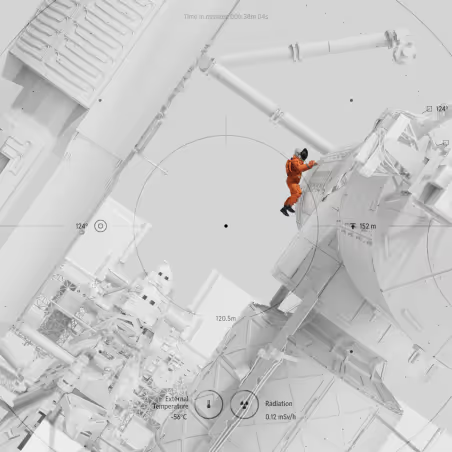
Distance | AR HUD Unity demo
We partnered with the Finnish startup Distance to help them showcase their groundbreaking spatial display technology
*
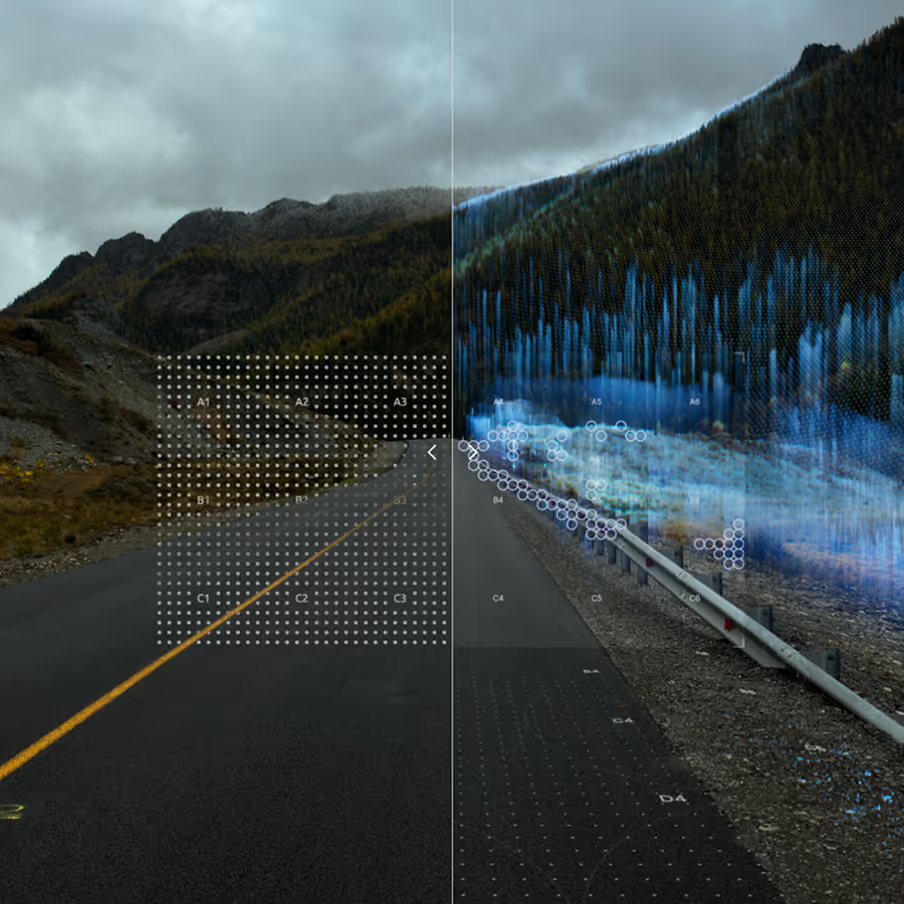
Distance | Infinite Pixel Depth
We were asked to find a way to illustrate main advantage of Distance XR display — Infinite Pixel Depth — in a static image
*
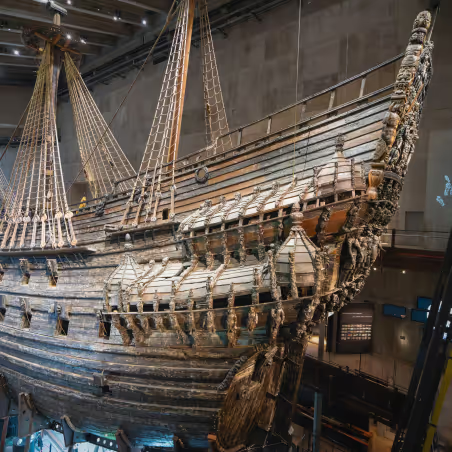
Vasa Museum | Visitor experience concept
An AR solution that adds a new layer of depth to exploring Stockholm’s most visited museum, with multiple overlays enriching the visitor experience